Tribal Healthcare
Project 956: knowing which engagements actually make money
Profitability was spread across time-tracking, invoices, and loose documents. Project 956 turns it into a per-clinic, per-engagement margin view you can trust.
Context
A healthcare services company runs billing, pre-award, startup, and data-entry engagements on behalf of Native American tribal clinics across the country. Its operations team needed a straight answer to a hard question: per clinic and per engagement, is the work profitable, where are costs running high, and is revenue keeping pace with labor? The data to answer it was scattered: labor in BigTime, revenue in client invoices, costs in contractor and vendor documents. The same clinic showed up under dozens of name spellings, so any margin figure was a reconstruction rather than a fact.
Approach
We built an engagement-level cost-tracking and economics tool. It syncs four data types from BigTime (staff, loaded labor rates, time entries tagged to clinic engagements, and client invoices) and accepts the documents BigTime never captured through SmartBox (patent pending), CompVer’s multi-modal ingestion engine. SmartBox routes each file type to the right parser, pulls hours, expenses, and billing facts from XLSX, PDF, CSV, and EML files, and flags conflicts (like an email-stated payment total that doesn’t match its attached invoice) before anything is trusted. Nothing lands in the data until a person approves it, and every extraction and every human correction is written to an append-only audit log.
Everything resolves through an entity-canonicalization layer that maps all those clinic-name variants to one canonical record before a single cost is computed. Labor cost uses loaded rates matched to the compensation period covering each time entry’s date, so a mid-year rate change lands in the right months instead of being averaged away.
Outcome
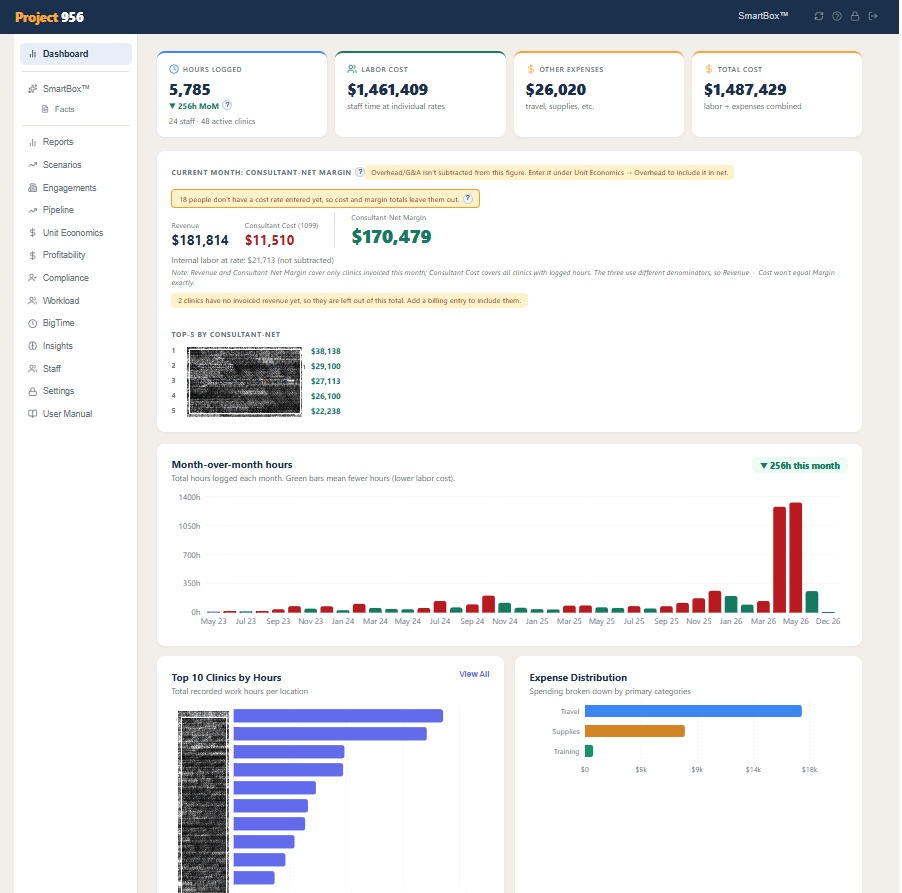
The team gets a per-clinic and per-engagement view of hours, labor cost, revenue billed, and gross margin, and, just as important, a view it can trust. The system surfaces explicit honesty markers wherever the data won’t support a confident figure: unconfirmed staff rates, clinics whose billing doesn’t reach as far back as their labor records, time that couldn’t be linked to a job. It refuses to produce a number rather than fabricate one, and every estimated figure carries a basis label (actuals, benchmark, seed, or no-basis) so a reader knows exactly how much weight it holds. The result is engagement economics the team can act on, instead of guesses dressed up as data.
A constraint like this one? Or a different one?
Start an inquiry. Describe what's breaking down. We'll tell you whether custom software is the fix, and what it would take.
Start an inquiry